
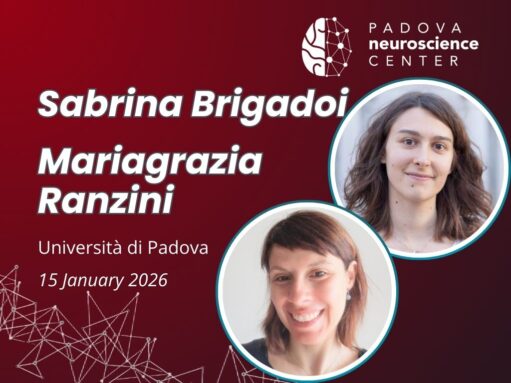
by Sabrina Brigadoi and Mariagrazia Ranzini, University of Padova
When: 15 January 2026 at 3:00 pm
Where: Sala Seminari VIMM (Fondazione Ricerca Biomedica Avanzata, Via Orus 2, Padova)
Abstract: Functional near-infrared spectroscopy (fNIRS) is a non-invasive optical technique used to monitor cortical functional activity. Oxy- (HbO) and deoxy-hemoglobin (HbR) are the main absorbers of light in the red and near-infrared range, while other human tissues are relatively transparent to light at these wavelengths. Changes in the measured light intensity emitted by a source placed on the scalp and backscattered to a detector placed nearby can be used to recover changes in HbO and HbR concentration occurring in the superficial cortical layer.
fNIRS is a cost-effective, portable, easy-to-use, silent and non-invasive cortical imaging technique, which allows unconstrained movements of participants. Therefore, it is ideal in settings requiring participants to move (e.g., study functional activity during tasks requiring movement), to behave in everyday-life settings (e.g., children playing, etc.) or in clinical context at the cot/bed-side.
In this seminar, we will show some exemplary applications of fNIRS in two different contexts: in clinical settings, in the neonatal intensive care unit, to study preterms, and in lab-based settings to study the neural correlates of numerical cognition and motor action across the lifespan.
Preterm newborns are more prone to experience glycemic variability at birth, due to an immaturity of the glucose control system, which develops during the last trimester of pregnancy. Glucose is usually measured twice a day with a heel-prick sampling and glucose control is then performed based on operational thresholds, by administering glucose boluses or changing the diet. This type of glucose control does not consider the individual brain’s health. However, several studies show an association between glucose variability at birth and neurodevelopmental outcome. We will present some results of the BabyGlucoLight project, which aims to study, for the first time, how brain hemodynamics changes, at the individual level, during hypoglycemic events and how brain hemodynamics is impacted by glucose variability in preterms. Furthermore, we will present the on-going Prometeus project, which aims to individualize preterm nutritional diet based on both cerebral hemodynamics and metabolites concentration (glucose, lactate and ketone bodies).
fNIRS is useful also to study the neural correlates of cognition and action in ecological contexts. In our lab, we use fNIRS to investigate numerical cognition in an embodied perspective. Action accounts of cognition highlight how cognition is built upon sensorimotor experience. In the context of numerical cognition, it is still largely unknown how the sensorimotor system contributes to number processing and mathematical abilities across the lifespan. We will present some results from the GRINP project, through which we investigated common frontoparietal activity during both number comparison and hand grasping, and how this common activity varies as a function of individual differences in mathematical expertise. Also, we will present the ongoing NumAct project, aimed at investigating the development of intermingled processes between number and hand grasping across the lifespan, specifically, in children, in young adults, and in the elderly.