
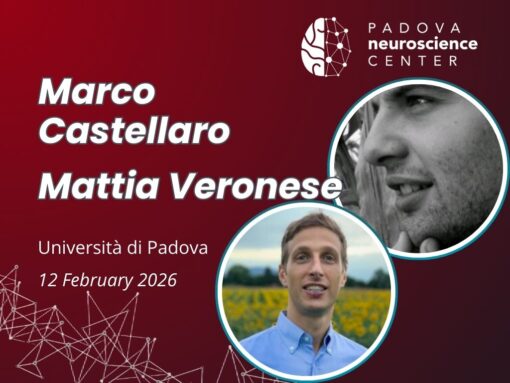
by Marco Castellaro and Mattia Veronese, University of Padova
When: 12 February 2026 at 3:00 pm
Where: Sala Seminari VIMM (Fondazione Ricerca Biomedica Avanzata, Via Orus 2, Padova)
Abstract:
Brain perfusion and clearance measured with MRI: from modeling to artificial intelligence quantification methods (Marco Castellaro)
Brain perfusion and fluid clearance are tightly coupled processes that sustain brain metabolism and waste removal, and their impairment is increasingly linked to ageing and neurodegeneration. MRI offers a unique, non-invasive window into both domains; however, translating rich image signals into robust physiological markers remains challenging due to low signal-to-noise ratio, inter-subject variability, and the need to disentangle concurrent transport mechanisms.
This seminar presents a methodological pathway “from modelling to artificial intelligence” for quantifying perfusion and clearance with MRI. I will first introduce biophysical and kinetic models used to interpret dynamic perfusion data, and then discuss how AI-driven quantification—particularly deep learning—can improve parameter estimation and robustness.
In the second part of the talk, I will show how clearance can be indirectly investigated using AI-based segmentation techniques to provide a morphological characterization of the choroid plexus, a highly vascularized structure involved in cerebrospinal fluid production and brain homeostasis.
Normative modelling and imaging transcriptomics for neuroimaging sciences (Mattia Veronese)
Despite numerous advancements in neuroimaging sciences, the use of neuroimaging as a quantitative biomarker for clinical applications remains limited. One key challenge is the predominant reliance on cross-sectional frameworks for analyzing neuroimaging data, rather than focusing on single-subject statistics. Additionally, cross-sectional approaches often fail to account for variability within the data, classifying it as noise or measurement error. While this may not pose significant issues for most neuroimaging studies, it becomes critically important in molecular neuroimaging due to the considerable inherent variability in molecular functions across populations.
This talk aims to address these limitations by presenting a framework to extract transcriptomic signatures from neuroimaging scans and exploring the technical feasibility of applying normative modeling to molecular neuroimaging modalities.